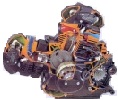
I translated for you this thing written. I have done this, if you want you can say your opinion.
http://www.ttacademy.org/officina/motorebilancia.htm the original link
There ' a lot of confusion in the talk or look up information on the balancing of the trees of the two-cylinder engine with 90 ° rods constrained to a single crank pin (Ducati , Guzzi , etc. . ) , Let's do some ' clarity :
The bikes that come out of the factory have (almost) always a good balance of the crankshaft , but often , due to processing or as a result of mechanical failure, you have to change the connecting rods with others, changing rods ( or alleggerendole ) change their weight ( think of who puts them in titanium) and as a result we will have to re- balance the crankshaft.
This writing is not intended as an exhaustive treatise on the balance ( I would not be able ) , with difficult calculations and heavy talk about the various harmonics , wants to be a practical guide to what the normal enthusiast can do with the normal means in its budget or DIY .
I will use simple language so as not to create doubts.
The theory and ' fairly straightforward, the counterweight ( ax ) must balance shaft in opposition to the total weight of a connecting rod ( body + screw + rod bearing) and a plunger ( piston + piston ring + pin + Seegers ) , more the rotating part of the second connecting rod .
This is because at every turn of the crankshaft counterweight will twice in opposition to the piston ( a piston of the cylinder and a vertical to horizontal ) , giving 0 ° to the first , the second and ' to 90 ° , the remaining 270 ° are " empty" .
This total weight balance piston / connecting rod allows you to cancel the vibrations triggered by the reversal of motion at top dead center , and in the remaining intermediate points ?
They are generated very little vibration and balancing is done with auxiliary shafts , then (in our motor), the problem does not arise.
And of extreme importance that the connecting rods and the pistons have exactly the same weight (at least to the tenth of a gram) , if a connecting rod ( or a piston ) has a different weight that we have to lighten / a heavier up to bring it to the weight of the one / to lighter.
The connecting rods of the old Guzzi have a surplus at the ends of metal that serves this purpose ( Ducati those not, are more slender and light ) .
Another thing of great importance and ' the balance of the connecting rod, connecting rod feet ( and heads ) must have the same weight (eg 360 g heads , feet 90 g ) , we will discuss this later.
In order to balance the tree we build the lathe a metal ring to constrain ( with strong screws ) to the crank pin , this ring will have to be exactly the weight to balance with an accuracy of a tenth of a gram
CALCULATION OF THE WEIGHT OF BALANCE
To carry out the calculations that lead to weight balance must weigh a complete rod ( rod , bushings and screws) , weigh a plunger ( piston , piston pin, piston rings and snap rings ), find the weight of the rotating part of the second connecting rod ( usually about 60% of the total weight ) with a pretty simple system :
building a support in the form of [ the lower part acts as a base , the high ledge fits into the big end (which is' free to rotate ) , the other end of the connecting rod must settle the balance remaining parallel to the plane ( if the angle and ' very different rod and ' hanging or leaning against the distorting support the weight).
I remember that some electronic kitchen scales weigh 1/10 of a gram.
The displayed weight and ' the one with reciprocating rod , based on:
total weight rod -
weight displayed on the scale ( alternating ) =
part weight / rod that has rotary motion .
then :
weight 1 piston complete +
weight rod 1 full +
weight depending on the rotating rod =
weight to balance
Construction of the counterweight
Once you determine the weight to balance , you have to build a ring formed by two half-shells () and with through screws from the ends is bound to the pivot shaft in place of the connecting rods, and ' good practice to insert between the ring and the shaft two old bushings to avoid damaging the pin adjusted with involuntary rotations of the ring.
The bushings have a thickness to be taken into account in the construction (turning) of the ring.
I do a drawing taking into account the density of the metal (iron) and that of ' fact , I do it off the edge of the bearing journal , I take into account in the processing of bushings that must be inserted between the pin and ring , I leave an excess of weight (about 30-50 grams), which I take to complete construction , the hole on the edge of the holes where the screws insert (_) that bind him to the tree and cut it in half ( I) .
I put 8 mm bolts . taking into account ( during drilling ) which one end is threaded to lock the two half-shells on the pivot shaft .
A complete working port to the exact weight tornendo the outer edge.
Balancing "static"
Once bound ring homebuilt , the tree pose on the knives (blades perfectly straight and parallel to the floor or two pairs of rollers (bearings ) on which to build the tree ), the shaft will rotate to position the most heavy at the bottom, if this is' the ax of the tree , we remove weight until the tree will remain in any position we put ( cleaver in up-down - left-right ) .
It is advisable to remove material ALWAYS in the most distant from the center of rotation of the (outer ) .
If the bottom and ' the counterweight ( rare) we will have to weigh the ax by welding in the old lightening holes .
Once you've done all this and ' prudent bring the tree into a center adjustments to subject it to balance "dynamic" , and this ' control over the work done ( Security + ) and e ' cheap, in Portogruaro ( VE) ask about 30 Euro .
The dynamic balancing is to balance the tree causing it to rotate on a special machine (type wheel balancer ) , if the static balance and ' was done well, take off a few tenths of a gram.
I remember that a motor with rotating parts well balanced :
vibrates less , lasts longer , salt better speed , allows a more relaxed and does not generate resonances / breakages in the frame / plastics.